Simulate recurrent events from a two-stage model with structured gamma frailties
Source:R/recurrent.marginal.R
sim_recurrentTS.RdSimulates recurrent event data with two event types and a terminal event,
using a parametric two-stage frailty model. The construction ensures that the
marginal rates are approximately correct: conditional on survival,
\(E(dN_j \mid D > t) \approx\) cumhazj, and the hazard of death
equals death.cumhaz.
Usage
sim_recurrentTS(
  n,
  cumhaz,
  cumhaz2,
  death.cumhaz = NULL,
  nu = rep(1, 3),
  share1 = 0.3,
  vargamD = 2,
  vargam12 = 0.5,
  gap.time = FALSE,
  max.recurrent = 100,
  cens = NULL,
  ...
)
Arguments
- n
Number of subjects to simulate.
- cumhaz
Two-column matrix
(time, cumhaz)giving the target marginal cumulative rate of the first recurrent event type.- cumhaz2
Two-column matrix
(time, cumhaz)giving the target marginal cumulative rate of the second recurrent event type.- death.cumhaz
Two-column matrix
(time, cumhaz)giving the cumulative hazard of the terminal event.- nu
Numeric vector of length 3: the powers \((\nu_1, \nu_2, \nu_3)\) applied to the frailty components (see Details). Must satisfy \(\nu_j > -1/\text{shape}\). Default is
rep(1, 3).Proportion of the total death frailty variance assigned to the first component \(Z_{d1}\). The remainder goes to \(Z_{d2}\). Must be in \((0, 1)\). Default is
0.3.- vargamD
Total variance of the death frailty \(Z_\text{death}\). Default is
2.- vargam12
Variance of the shared recurrent-event frailty \(Z_{12}\). Default is
0.5.- gap.time
Logical. If
TRUE, event times are drawn as gap times rather than calendar times. Default isFALSE.- max.recurrent
Maximum number of recurrent events per subject. Default is
100.- cens
Rate of exponential censoring. If
NULL(default), no administrative censoring is applied.- ...
Further arguments passed to lower-level simulation functions.
Value
A data frame in counting-process format (one row per event interval
per subject) with columns id, start, stop,
entry, time, status, and death. Attributes
store the (possibly adjusted) cumulative hazards used in simulation and
the frailty parameters.
Details
The frailty structure uses three gamma random variables \(Z_{d1}\),
\(Z_{d2}\), \(Z_{12}\) to induce dependence:
$$Z_\text{death} = Z_{d1} + Z_{d2}, \quad
Z_1 = Z_{d1}^{\nu_1} Z_{12}, \quad
Z_2 = Z_{d2}^{\nu_2} Z_{12}^{\nu_3}.$$
The parameters share1 and vargamD control how the death frailty
splits between the two components, and vargam12 controls the shared
recurrent-event frailty. Setting \(\nu = (1,1,1)\) with share1 = 0.5
gives a symmetric structure; varying \(\nu\) allows asymmetric dependence.
Examples
data(CPH_HPN_CRBSI)
dr    <- CPH_HPN_CRBSI$terminal
base1 <- CPH_HPN_CRBSI$crbsi
base4 <- CPH_HPN_CRBSI$mechanical

rr <- sim_recurrentTS(1000, base1, base4, death.cumhaz = dr)
dtable(rr, ~death + status)
#>
#>       status    0    1    2
#> death
#> 0             138 2394  384
#> 1             861    0    0
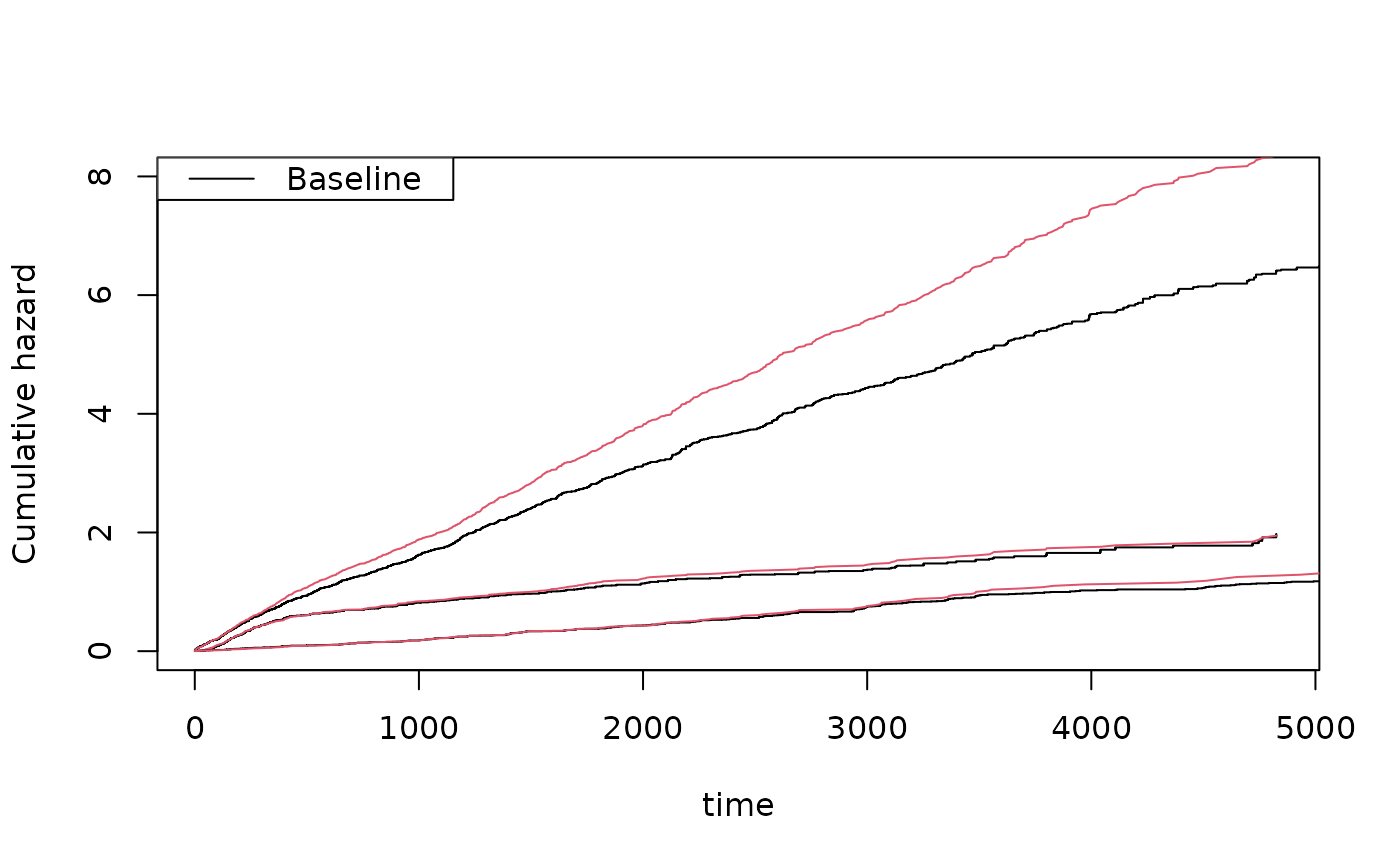
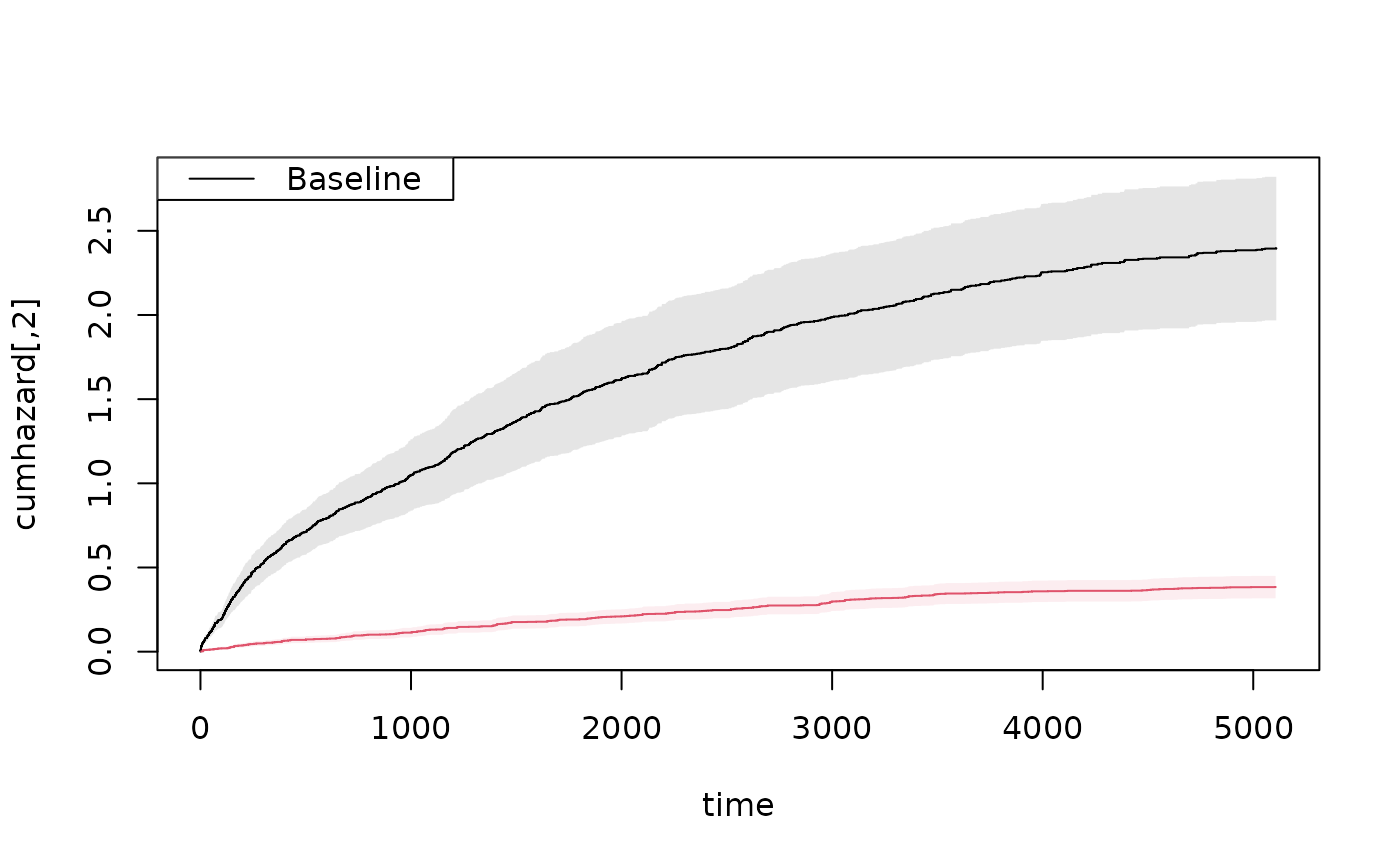
mets:::showfitsim(causes = 2, rr, dr, base1, base4)