Simulate recurrent events with two event types and a terminal event
Source:R/recurrent.marginal.R
sim_recurrentII.RdSimulates recurrent event data with up to two distinct event types and an optional terminal event (death), based on user-supplied cumulative hazard functions. Dependence between processes can be introduced via shared or correlated gamma-distributed frailties.
Usage
sim_recurrentII(
  n,
  cumhaz,
  cumhaz2,
  death.cumhaz = NULL,
  r1 = NULL,
  r2 = NULL,
  rd = NULL,
  rc = NULL,
  dependence = 0,
  var.z = 1,
  cor.mat = NULL,
  cens = NULL,
  gap.time = FALSE,
  max.recurrent = 100,
  ...
)
Arguments
- n
Number of subjects to simulate.
- cumhaz
Two-column matrix
(time, cumhaz)giving the cumulative hazard of the first type of recurrent event.- cumhaz2
Two-column matrix
(time, cumhaz)giving the cumulative hazard of the second type of recurrent event.- death.cumhaz
Two-column matrix
(time, cumhaz)giving the cumulative hazard of the terminal event. IfNULL, no terminal event is simulated and follow-up ends at the end ofcumhaz.- r1
Optional numeric vector of length
nwith subject-specific relative risk multipliers for the first event type.- r2
Optional numeric vector of length
nwith subject-specific relative risk multipliers for the second event type.- rd
Optional numeric vector of length
nwith subject-specific relative risk multipliers for the terminal event.- rc
Optional numeric vector of length
nwith subject-specific multipliers for the exponential censoring rate.- dependence
Integer specifying the frailty structure. One of
0(independence),1(shared gamma frailty), or4(shared frailty for recurrent events only). See Details.- var.z
Variance of the gamma-distributed frailty. Default is
1.- cor.mat
Correlation matrix for the random effects. Used when
dependence = 2(insim_recurrent_list).- cens
Rate of exponential censoring. If
NULL(default), no additional censoring is applied.- gap.time
Logical. If
TRUE, event times are drawn as gap times (time since the last event) rather than calendar times. Default isFALSE.- max.recurrent
Maximum number of recurrent events allowed per subject. Default is
100.- ...
Further arguments passed to
sim_recurrent_list.
Value
A data frame in counting-process format (one row per event interval per subject) with columns:
- id
Subject identifier.
- start, entry
Interval start time.
- stop, time
Interval end time (event or censoring time).
- status
Event type at
stop:1or2for a recurrent event of the corresponding type,0for censoring.- death
Indicator for a terminal event (
1) or censoring/survival (0).
Attributes "cumhaz", "death.cumhaz", "rr", and
"rd" store the inputs used for simulation.
Details
The simulation proceeds by sequentially drawing the next event time from the specified cumulative hazards, taking the minimum of the two recurrent event times, and stopping each subject at death or administrative censoring.
Dependence between processes is controlled by dependence:
0Independence: all subjects have frailty fixed at 1.
1Shared frailty: all processes share a single gamma-distributed random effect with mean 1 and variance
var.z.4Recurrent-event frailty only: the two recurrent event processes share a gamma frailty but the terminal event is independent.
For more complex correlation structures across two event types and death, use
sim_recurrentTS.
See also
sim_recurrent, sim_recurrent_list,
sim_recurrentTS
Examples
data(CPH_HPN_CRBSI)
dr <- CPH_HPN_CRBSI$terminal
base1 <- CPH_HPN_CRBSI$crbsi
base4 <- CPH_HPN_CRBSI$mechanical
## Single recurrent event type, with and without terminal event
rr <- sim_recurrent(5, base1)
dlist(rr, . ~ id, n = 0)
#> id: 1
#> entry time status dtime fdeath death start stop
#> 1 0.0000 169.3049 1 5110 0 0 0.0000 169.3049
#> 6 169.3049 481.1343 1 5110 0 0 169.3049 481.1343
#> 11 481.1343 952.4639 1 5110 0 0 481.1343 952.4639
#> 16 952.4639 1681.5204 1 5110 0 0 952.4639 1681.5204
#> 21 1681.5204 2291.2539 1 5110 0 0 1681.5204 2291.2539
#> 26 2291.2539 3236.2176 1 5110 0 0 2291.2539 3236.2176
#> 31 3236.2176 3243.0040 1 5110 0 0 3236.2176 3243.0040
#> 35 3243.0040 3712.4692 1 5110 0 0 3243.0040 3712.4692
#> 37 3712.4692 3802.3129 1 5110 0 0 3712.4692 3802.3129
#> 39 3802.3129 3877.4558 1 5110 0 0 3802.3129 3877.4558
#> 41 3877.4558 4008.8353 1 5110 0 0 3877.4558 4008.8353
#> 43 4008.8353 5110.0000 0 5110 0 0 4008.8353 5110.0000
#> ------------------------------------------------------------
#> id: 2
#> entry time status dtime fdeath death start stop
#> 2 0.0000 836.2402 1 5110 0 0 0.0000 836.2402
#> 7 836.2402 1582.7756 1 5110 0 0 836.2402 1582.7756
#> 12 1582.7756 1909.3792 1 5110 0 0 1582.7756 1909.3792
#> 17 1909.3792 2788.0148 1 5110 0 0 1909.3792 2788.0148
#> 22 2788.0148 4131.8937 1 5110 0 0 2788.0148 4131.8937
#> 27 4131.8937 4542.2007 1 5110 0 0 4131.8937 4542.2007
#> 32 4542.2007 5110.0000 0 5110 0 0 4542.2007 5110.0000
#> ------------------------------------------------------------
#> id: 3
#> entry time status dtime fdeath death start stop
#> 3 0.0000 477.0110 1 5110 0 0 0.0000 477.0110
#> 8 477.0110 684.0066 1 5110 0 0 477.0110 684.0066
#> 13 684.0066 752.7554 1 5110 0 0 684.0066 752.7554
#> 18 752.7554 786.7790 1 5110 0 0 752.7554 786.7790
#> 23 786.7790 1523.6981 1 5110 0 0 786.7790 1523.6981
#> 28 1523.6981 1697.5033 1 5110 0 0 1523.6981 1697.5033
#> 33 1697.5033 2121.4121 1 5110 0 0 1697.5033 2121.4121
#> 36 2121.4121 2211.0749 1 5110 0 0 2121.4121 2211.0749
#> 38 2211.0749 2248.7271 1 5110 0 0 2211.0749 2248.7271
#> 40 2248.7271 3559.0995 1 5110 0 0 2248.7271 3559.0995
#> 42 3559.0995 3823.9527 1 5110 0 0 3559.0995 3823.9527
#> 44 3823.9527 4697.2929 1 5110 0 0 3823.9527 4697.2929
#> 45 4697.2929 4697.6391 1 5110 0 0 4697.2929 4697.6391
#> 46 4697.6391 5031.7334 1 5110 0 0 4697.6391 5031.7334
#> 47 5031.7334 5110.0000 0 5110 0 0 5031.7334 5110.0000
#> ------------------------------------------------------------
#> id: 4
#> entry time status dtime fdeath death start stop
#> 4 0.000 1570.693 1 5110 0 0 0.000 1570.693
#> 9 1570.693 3057.897 1 5110 0 0 1570.693 3057.897
#> 14 3057.897 3389.234 1 5110 0 0 3057.897 3389.234
#> 19 3389.234 3913.541 1 5110 0 0 3389.234 3913.541
#> 24 3913.541 3976.522 1 5110 0 0 3913.541 3976.522
#> 29 3976.522 5110.000 0 5110 0 0 3976.522 5110.000
#> ------------------------------------------------------------
#> id: 5
#> entry time status dtime fdeath death start stop
#> 5 0.000 1253.563 1 5110 0 0 0.000 1253.563
#> 10 1253.563 1947.437 1 5110 0 0 1253.563 1947.437
#> 15 1947.437 2075.897 1 5110 0 0 1947.437 2075.897
#> 20 2075.897 2211.924 1 5110 0 0 2075.897 2211.924
#> 25 2211.924 3991.204 1 5110 0 0 2211.924 3991.204
#> 30 3991.204 5084.684 1 5110 0 0 3991.204 5084.684
#> 34 5084.684 5110.000 0 5110 0 0 5084.684 5110.000
rr <- sim_recurrent(5, base1, death.cumhaz = dr)
dlist(rr, . ~ id, n = 0)
#> id: 1
#> entry time status dtime fdeath death start stop
#> 1 0.0000 350.6289 1 2996.717 1 0 0.0000 350.6289
#> 6 350.6289 362.1943 1 2996.717 1 0 350.6289 362.1943
#> 10 362.1943 884.5432 1 2996.717 1 0 362.1943 884.5432
#> 12 884.5432 1546.1629 1 2996.717 1 0 884.5432 1546.1629
#> 14 1546.1629 1701.7343 1 2996.717 1 0 1546.1629 1701.7343
#> 16 1701.7343 2996.7166 0 2996.717 1 1 1701.7343 2996.7166
#> ------------------------------------------------------------
#> id: 2
#> entry time status dtime fdeath death start stop
#> 2 0 209.9771 0 209.9771 1 1 0 209.9771
#> ------------------------------------------------------------
#> id: 3
#> entry time status dtime fdeath death start stop
#> 3 0.0000 509.7645 1 4193.438 1 0 0.0000 509.7645
#> 7 509.7645 4193.4377 0 4193.438 1 1 509.7645 4193.4377
#> ------------------------------------------------------------
#> id: 4
#> entry time status dtime fdeath death start stop
#> 4 0.0000 298.0493 1 2335.534 1 0 0.0000 298.0493
#> 8 298.0493 482.9285 1 2335.534 1 0 298.0493 482.9285
#> 11 482.9285 490.5588 1 2335.534 1 0 482.9285 490.5588
#> 13 490.5588 630.2717 1 2335.534 1 0 490.5588 630.2717
#> 15 630.2717 750.7360 1 2335.534 1 0 630.2717 750.7360
#> 17 750.7360 768.4209 1 2335.534 1 0 750.7360 768.4209
#> 18 768.4209 1510.5186 1 2335.534 1 0 768.4209 1510.5186
#> 19 1510.5186 1936.9710 1 2335.534 1 0 1510.5186 1936.9710
#> 20 1936.9710 2263.3131 1 2335.534 1 0 1936.9710 2263.3131
#> 21 2263.3131 2335.5340 0 2335.534 1 1 2263.3131 2335.5340
#> ------------------------------------------------------------
#> id: 5
#> entry time status dtime fdeath death start stop
#> 5 0.0000 358.8214 1 4797.555 1 0 0.0000 358.8214
#> 9 358.8214 4797.5555 0 4797.555 1 1 358.8214 4797.5555
## Verify that estimated rates recover the true baselines (increase n for precision)
rr <- sim_recurrent(100, base1, death.cumhaz = dr)
par(mfrow = c(1, 3))
mets:::showfitsim(causes = 1, rr, dr, base1, base1)
## Shared frailty across all processes
rr <- sim_recurrent(100, base1, death.cumhaz = dr, dependence = 1, var.z = 0.4)
dtable(rr, ~death + status)
#>
#> status 0 1
#> death
#> 0 26 221
#> 1 74 0
## Two event types; second type uses the mechanical complication rate
set.seed(100)
rr <- sim_recurrentII(100, base1, base4, death.cumhaz = dr)
dtable(rr, ~death + status)
#>
#> status 0 1 2
#> death
#> 0 10 295 39
#> 1 90 0 0
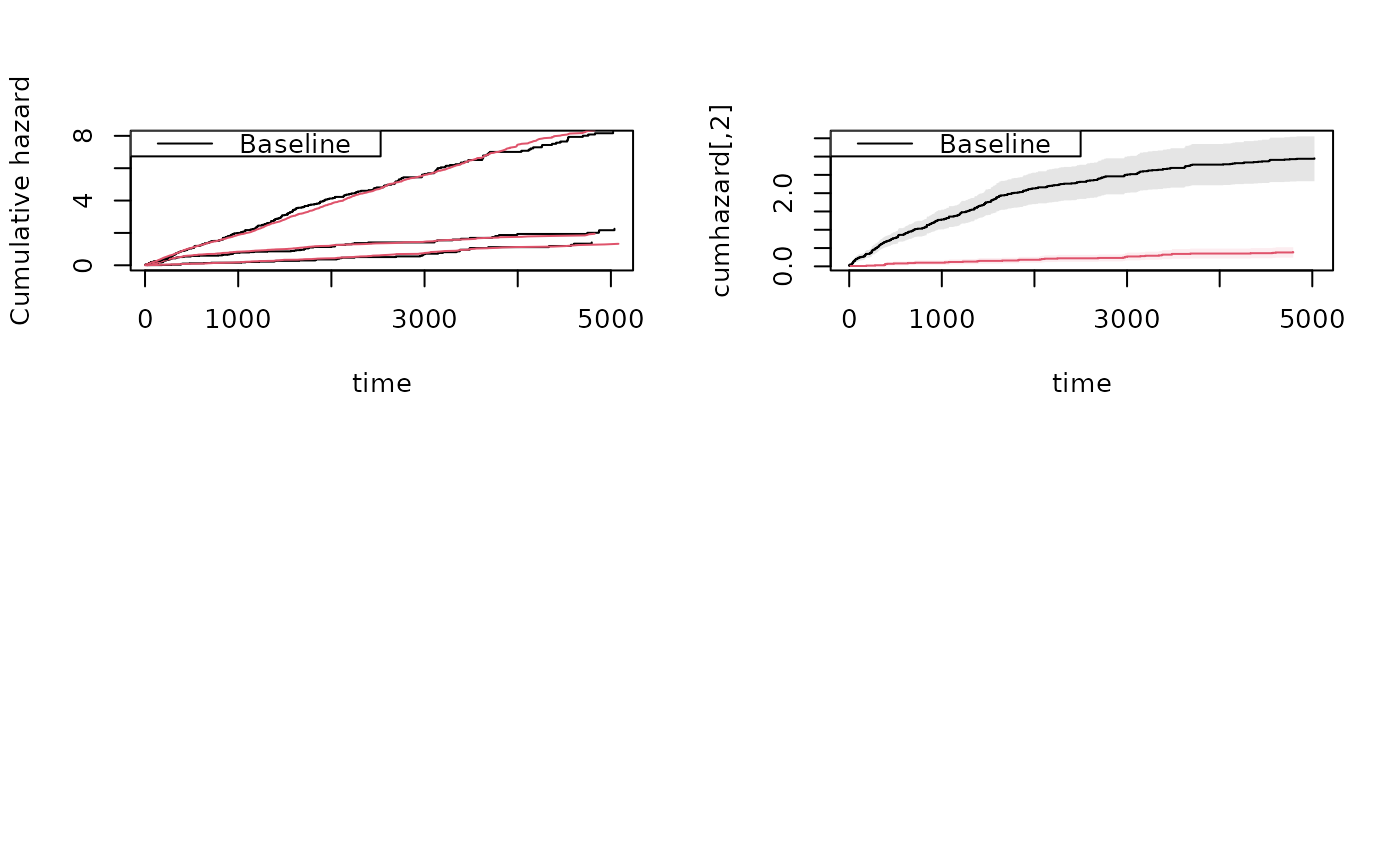
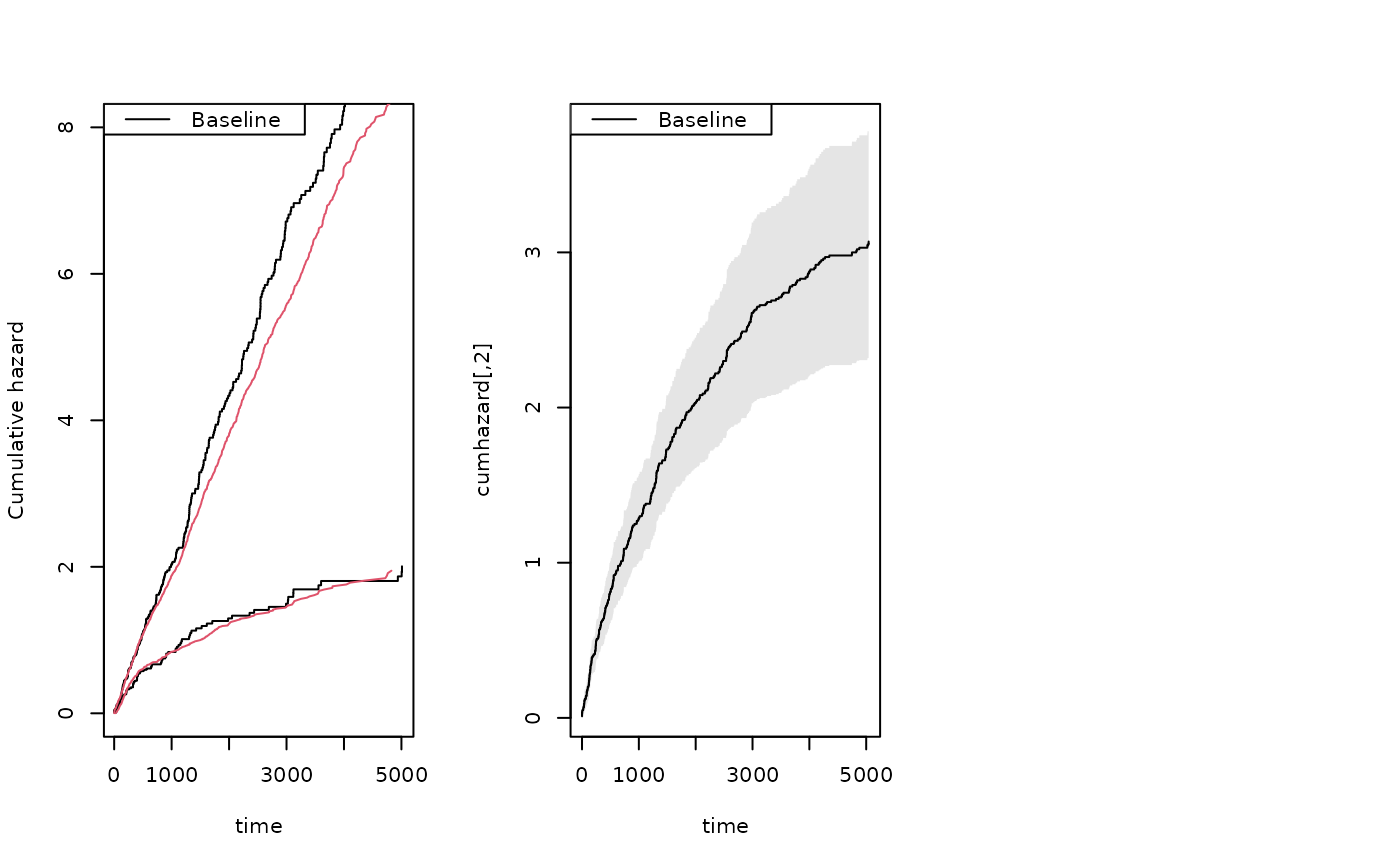
par(mfrow = c(2, 2))
 mets:::showfitsim(causes = 2, rr, dr, base1, base4)
## Three event types and two causes of death via sim_recurrent_list
set.seed(100)
cumhaz <- list(base1, base1, base4)
drl <- list(dr, base4)
rr <- sim_recurrent_list(100, cumhaz, death.cumhaz = drl, dependence = 0)
dtable(rr, ~death + status)
#>
#> status 0 1 2 3
#> death
#> 0 4 232 268 33
#> 1 70 0 0 0
#> 2 26 0 0 0
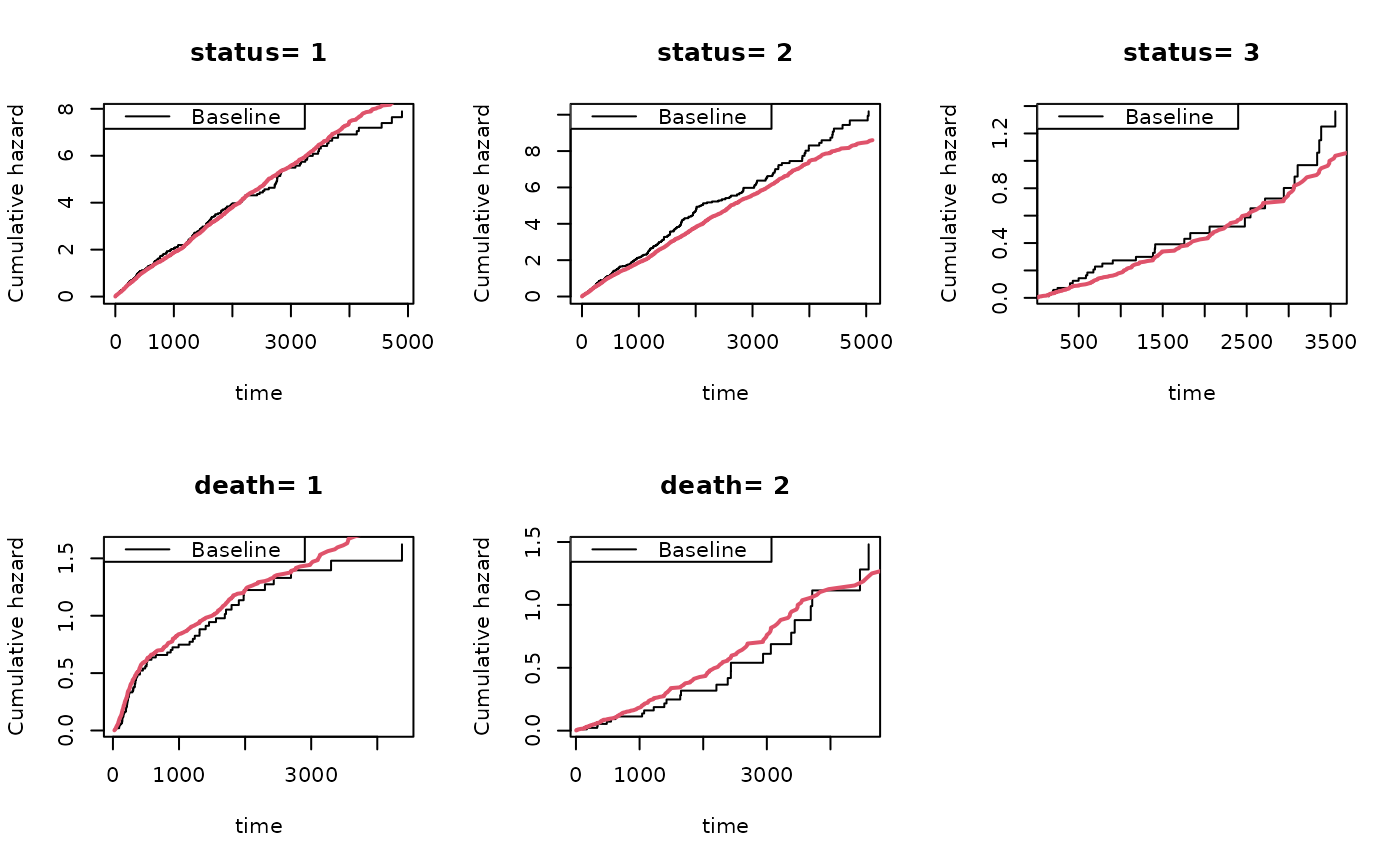
mets:::showfitsimList(rr, cumhaz, drl)
mets:::showfitsim(causes = 2, rr, dr, base1, base4)
## Three event types and two causes of death via sim_recurrent_list
set.seed(100)
cumhaz <- list(base1, base1, base4)
drl <- list(dr, base4)
rr <- sim_recurrent_list(100, cumhaz, death.cumhaz = drl, dependence = 0)
dtable(rr, ~death + status)
#>
#> status 0 1 2 3
#> death
#> 0 4 232 268 33
#> 1 70 0 0 0
#> 2 26 0 0 0
mets:::showfitsimList(rr, cumhaz, drl)