Simulates data that looks like fit from cause specific Cox models. Censor data automatically. When censoring is given in the list of causes this will give censoring that looks like the data. Covariates are drawn from data-set with replacement. This gives covariates like the data. Calls sim.phregs
Usage
sim.phregs(
  coxs,
  n,
  data = NULL,
  rr = NULL,
  strata = NULL,
  entry = NULL,
  extend = NULL,
  cens = NULL,
  rrc = NULL,
  ...
)
Arguments
- coxs
list of cox models.
- n
number of simulations.
- data
to extract covariates for simulations (draws from observed covariates).
- rr
possible vector of relative risk for cox model.
- strata
possible vector of strata
- entry
delayed entry variable for simulation.
- extend
to extend possible stratified baselines to largest end-point
- cens
specifies censoring model, if NULL then only censoring for each cause at end of last event of this type. if "is.matrix" then uses cumulative. hazard given, if "is.scalar" then uses rate for exponential, and if not given then takes average rate of in simulated data from cox model. But censoring can also be given as a cause.
- rrc
possible vector of relative risk for cox-type censoring.
- ...
arguments for rchaz, for example entry-time
Examples
library(mets)
data(bmt)
nsim <- 100;

cox1 <- phreg(Surv(time,cause==1)~strata(tcell)+platelet+age,data=bmt)
cox2 <- phreg(Surv(time,cause==2)~tcell+strata(platelet),data=bmt)
coxs <- list(cox1,cox2)
## just calls sim.phregs !
dd <- sim.phregs(coxs,nsim,data=bmt,extend=c(0.001))
scox1 <- phreg(Surv(time,status==1)~strata(tcell)+platelet+age,data=dd)
scox2 <- phreg(Surv(time,status==2)~tcell+strata(platelet),data=dd)

cbind(cox1$coef,scox1$coef)
#>                [,1]       [,2]
#> platelet -0.5215632 -0.8736568
#> age       0.4058943  0.4505475
cbind(cox2$coef,scox2$coef)
#>            [,1]       [,2]
#> tcell 0.4153706 0.04614013
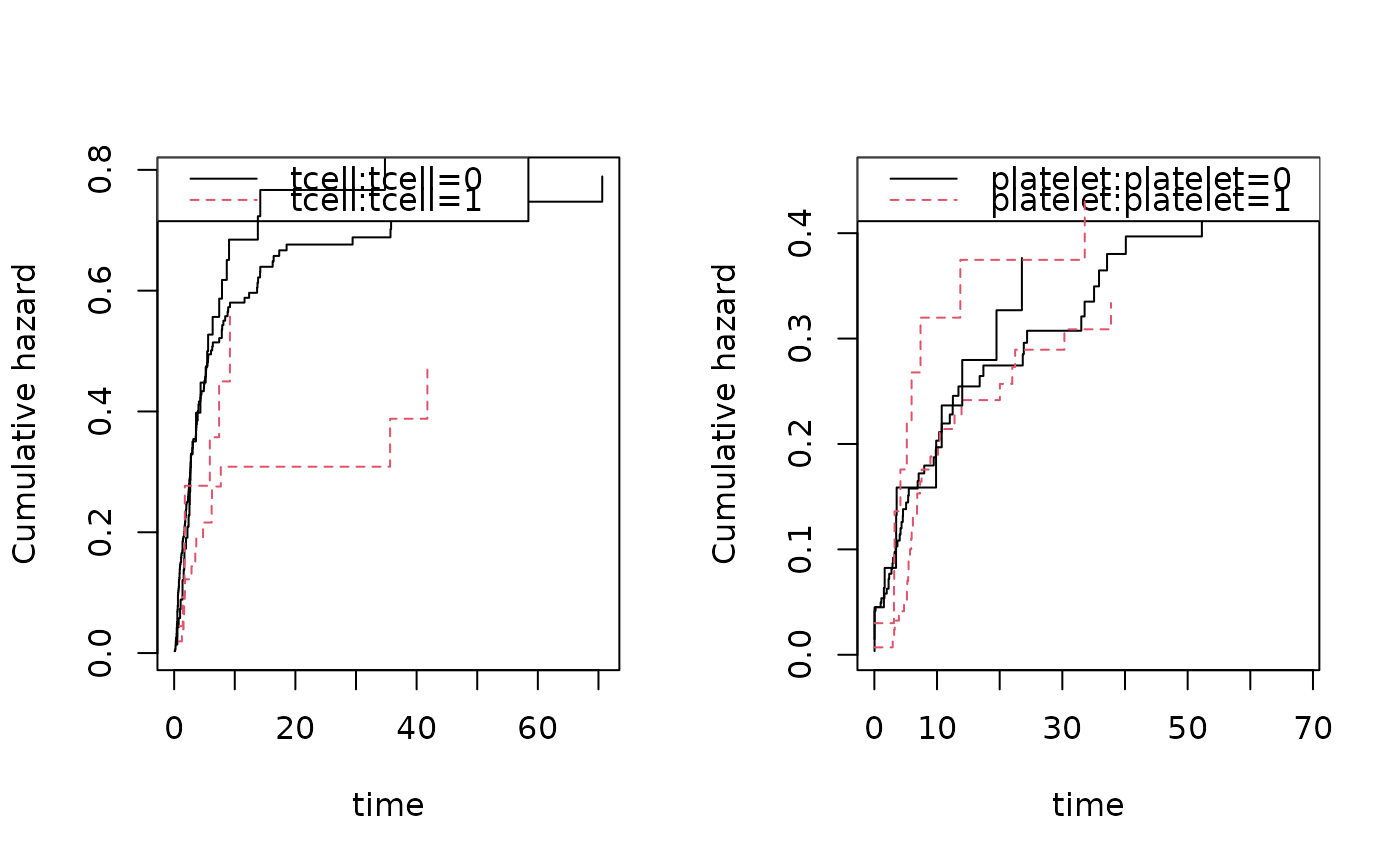
par(mfrow=c(1,2))
plot(cox1); plot(scox1,add=TRUE);
plot(cox2); plot(scox2,add=TRUE);