
Estimate the probability of exceeding k recurrent events by time t
Source:R/recurrent.marginal.R
prob_exceed_recurrent.RdEstimates \(P(N(t) \geq k)\) as a function of time \(t\), for a range of thresholds \(k\), in the presence of a terminal event (death). The estimator is based on the cumulative incidence of "reaching \(k\) events", treating death as a competing risk. Confidence intervals are computed on the log or plain scale.
Usage
prob_exceed_recurrent(
  formula,
  data,
  cause = 1,
  death.code = 2,
  cens.code = 0,
  exceed = NULL,
  marks = NULL,
  all.cifs = FALSE,
  return.data = FALSE,
  conf.type = c("log", "plain"),
  level = 0.95,
  ...
)
Arguments
- formula
A formula with an
Eventresponse giving the exit time and status (and optionally entry time). The right-hand side may includecluster()andstrata().- data
A data frame containing all variables in
formula.- cause
Integer code for the recurrent event of interest. Default is
1.- death.code
Integer code for the terminal event. Default is
2.- cens.code
Integer code for censoring. Default is
0.- exceed
Integer vector of thresholds \(k\) to evaluate. If
NULL(default), all observed cumulative counts are used.- marks
Optional numeric vector of event weights. If non-
NULL, cumulative counts are formed as weighted sums of events rather than simple counts. Must have the same length asnrow(data).- all.cifs
Logical. If
TRUE, the fittedcifobject for each threshold is returned incif.exceed. Default isFALSE.- return.data
Logical. If
TRUE, the constructed dataset for each threshold is returned indataList. Default isFALSE.- conf.type
Type of confidence interval transformation:
"log"(default) or"plain".- level
Confidence level. Default is
0.95.- ...
Further arguments passed to
cif.
Value
An object of class "exceed" with the following components:
- time
Vector of evaluation time points.
- prob
Array of dimension
(length(time), length(exceed) + 1,
    nstrata)
containing \(P(N(t) \geq k)\) for each threshold and stratum. The first column gives \(P(N(t) < \text{exceed}[1])\).- se.prob
Standard errors of
prob.- lower, upper
Pointwise confidence interval bounds.
- meanN
Estimated mean number of events \(E(N(t))\) (single stratum only;
NULLfor stratified analyses).- meanN2, varN
Second moment and variance of \(N(t)\) (single stratum only).
- exceed
Thresholds evaluated (excluding zero).
- cif.exceed
List of fitted
cifobjects (ifall.cifs = TRUE).- dataList
List of datasets for each threshold (if
return.data = TRUE).- nstrata, strata.levels, strata.name
Stratification information.
Use plot() and summary() methods for visualisation and
tabulation.
Details
For each threshold \(k\) in exceed, the function identifies the
first time each subject reaches \(k\) events, then fits a competing risks
model (cif) with "reaching \(k\) events" as the event of
interest and death as the competing event. Strata are supported. When
marks is NULL, each event contributes equally; otherwise events
are weighted by their mark values before cumulative counts are formed.
References
Scheike, T. H., Eriksson, L., and Tribler, P. (2019). The mean, variance and correlation for bivariate recurrent events with a terminal event. Journal of the Royal Statistical Society, Series C, 68(5).
Examples
data(hfactioncpx12)
dtable(hfactioncpx12, ~status)
#>
#> status
#> 0 1 2
#> 617 1391 124
#>
oo <- prob_exceed_recurrent(Event(entry, time, status) ~ cluster(id),
hfactioncpx12, cause = 1, death.code = 2)
plot(oo)
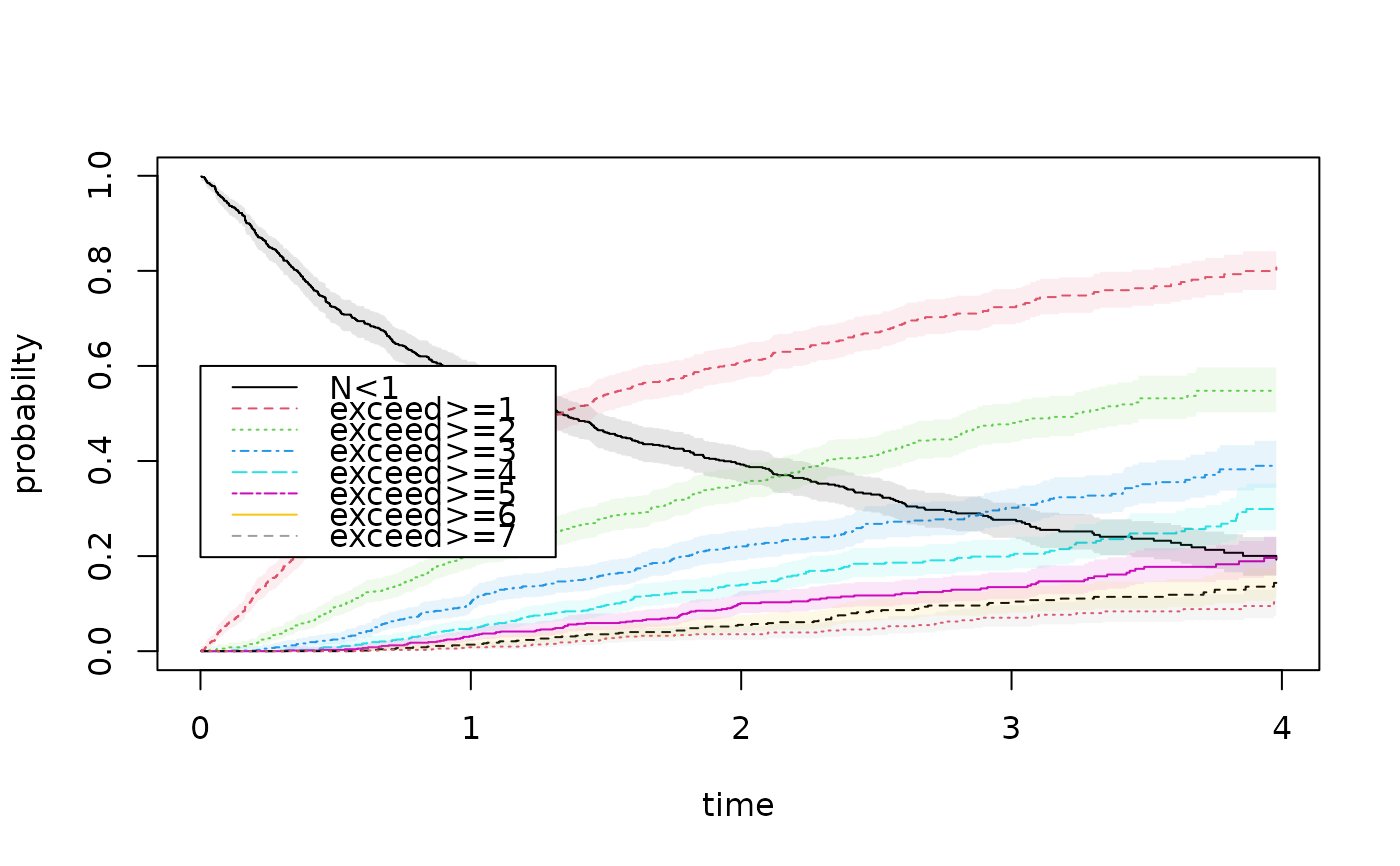 summary(oo, times = c(1, 2, 5))
#> $prob
#> times N<1 exceed>=1 exceed>=2 exceed>=3 exceed>=4
#> [1,] 1 0.9978807 0.5747460 0.4252540 0.2008652 0.1012955 0.04794006
#> [2,] 2 1.9967128 0.3925156 0.6074844 0.3509483 0.2205076 0.13989818
#> [3,] 5 3.9793816 0.1925999 0.8074001 0.5477499 0.3899373 0.29900312
#> exceed>=5 exceed>=6 exceed>=7
#> [1,] 0.03153223 0.01371012 0.008229099
#> [2,] 0.10092792 0.05533511 0.035595440
#> [3,] 0.19615192 0.14357991 0.103037717
#>
#> $se
#> times N<1 exceed>=1 exceed>=2 exceed>=3 exceed>=4
#> [1,] 1 0.9978807 0.01827977 0.01827977 0.01481729 0.01116527 0.007907269
#> [2,] 2 1.9967128 0.01862412 0.01862412 0.01832598 0.01592337 0.013395849
#> [3,] 5 3.9793816 0.02129779 0.02129779 0.02413438 0.02515176 0.024909447
#> exceed>=5 exceed>=6 exceed>=7
#> [1,] 0.006470709 0.004305759 0.003345689
#> [2,] 0.011774638 0.008883381 0.007151615
#> [3,] 0.020706361 0.019083117 0.016923719
#>
#> $lower
#> times
#> [1,] 1 0.9978807 0.6091060 0.3908940 0.1738256 0.08161439 0.0346977
#> [2,] 2 1.9967128 0.4279431 0.5720569 0.3168070 0.19140637 0.1159594
#> [3,] 5 3.9793816 0.2332821 0.7667179 0.5024323 0.34362952 0.2539590
#>
#> [1,] 0.02109017 0.007408243 0.003709206
#> [2,] 0.08029840 0.040397144 0.024009120
#> [3,] 0.15949140 0.110652445 0.074677237
#>
#> $upper
#> times
#> [1,] 1 0.9978807 0.5373658 0.4626342 0.2321109 0.1257227 0.06623635
#> [2,] 2 1.9967128 0.3548940 0.6451060 0.3887690 0.2540334 0.16877894
#> [3,] 5 3.9793816 0.1497591 0.8502409 0.5971550 0.4424855 0.35203666
#>
#> [1,] 0.0471443 0.02537272 0.01825676
#> [2,] 0.1268574 0.07579680 0.05277309
#> [3,] 0.2412392 0.18630579 0.14216877
#>
summary(oo, times = c(1, 2, 5))
#> $prob
#> times N<1 exceed>=1 exceed>=2 exceed>=3 exceed>=4
#> [1,] 1 0.9978807 0.5747460 0.4252540 0.2008652 0.1012955 0.04794006
#> [2,] 2 1.9967128 0.3925156 0.6074844 0.3509483 0.2205076 0.13989818
#> [3,] 5 3.9793816 0.1925999 0.8074001 0.5477499 0.3899373 0.29900312
#> exceed>=5 exceed>=6 exceed>=7
#> [1,] 0.03153223 0.01371012 0.008229099
#> [2,] 0.10092792 0.05533511 0.035595440
#> [3,] 0.19615192 0.14357991 0.103037717
#>
#> $se
#> times N<1 exceed>=1 exceed>=2 exceed>=3 exceed>=4
#> [1,] 1 0.9978807 0.01827977 0.01827977 0.01481729 0.01116527 0.007907269
#> [2,] 2 1.9967128 0.01862412 0.01862412 0.01832598 0.01592337 0.013395849
#> [3,] 5 3.9793816 0.02129779 0.02129779 0.02413438 0.02515176 0.024909447
#> exceed>=5 exceed>=6 exceed>=7
#> [1,] 0.006470709 0.004305759 0.003345689
#> [2,] 0.011774638 0.008883381 0.007151615
#> [3,] 0.020706361 0.019083117 0.016923719
#>
#> $lower
#> times
#> [1,] 1 0.9978807 0.6091060 0.3908940 0.1738256 0.08161439 0.0346977
#> [2,] 2 1.9967128 0.4279431 0.5720569 0.3168070 0.19140637 0.1159594
#> [3,] 5 3.9793816 0.2332821 0.7667179 0.5024323 0.34362952 0.2539590
#>
#> [1,] 0.02109017 0.007408243 0.003709206
#> [2,] 0.08029840 0.040397144 0.024009120
#> [3,] 0.15949140 0.110652445 0.074677237
#>
#> $upper
#> times
#> [1,] 1 0.9978807 0.5373658 0.4626342 0.2321109 0.1257227 0.06623635
#> [2,] 2 1.9967128 0.3548940 0.6451060 0.3887690 0.2540334 0.16877894
#> [3,] 5 3.9793816 0.1497591 0.8502409 0.5971550 0.4424855 0.35203666
#>
#> [1,] 0.0471443 0.02537272 0.01825676
#> [2,] 0.1268574 0.07579680 0.05277309
#> [3,] 0.2412392 0.18630579 0.14216877
#>