A general implementation of Structural Equation Models with latent variables (MLE, 2SLS, and composite likelihood estimators) with both continuous, censored, and ordinal outcomes (Holst and Budtz-Joergensen (2013) doi:10.1007/s00180-012-0344-y). Mixture latent variable models and non-linear latent variable models (Holst and Budtz-Joergensen (2020) doi:10.1093/biostatistics/kxy082). The package also provides methods for graph exploration (d-separation, back-door criterion), simulation of general non-linear latent variable models, and estimation of influence functions for a broad range of statistical models.
Installation
install.packages("lava", dependencies=TRUE)
library("lava")
demo("lava")
For graphical capabilities the Rgraphviz package is needed (first install the BiocManager package)
# install.packages("BiocManager")
BiocManager::install("Rgraphviz")
or the igraph or visNetwork packages
install.packages("igraph")
install.packages("visNetwork")
The development version of lava may also be installed directly from github:
# install.packages("remotes")
remotes::install_github("kkholst/lava")
Citation
To cite that lava package please use one of the following references
Klaus K. Holst and Esben Budtz-Joergensen (2013). Linear Latent Variable Models: The lava-package. Computational Statistics 28 (4), pp 1385-1453. http://dx.doi.org/10.1007/s00180-012-0344-y
@article{lava,
  title = {Linear Latent Variable Models: The lava-package},
  author = {Klaus Kähler Holst and Esben Budtz-Jørgensen},
  year = {2013},
  volume = {28},
  number = {4},
  pages = {1385-1452},
  journal = {Computational Statistics},
  doi = {10.1007/s00180-012-0344-y}
}
Klaus K. Holst and Esben Budtz-Jørgensen (2020). A two-stage estimation procedure for non-linear structural equation models. Biostatistics 21 (4), pp 676-691. http://dx.doi.org/10.1093/biostatistics/kxy082
Examples
Influence functions
Construct estimate objects from parameter coefficients and estimated influence functions
a <- estimate(coef=c("a"=0.5), IC=scale(rnorm(10)), id=1:10)
b <- estimate(coef=c("b"=0.8), IC=scale(rnorm(10)), id=6:15)
Alternatively, we can construct estimate objects directly from an existing model object (glm(), mets::phreg(), targeted::cate(), …)
estimate(modelobj, id, ...)We can now merge the estimate objects to obtain their joint distribution via their estimated influence functions
e <- c(a, b)
vcov(e) # joint distribution
#>            a          b
#> a 0.09000000 0.01469326
#> b 0.01469326 0.09000000
summary(e, null=c(0, 0))
#> Call: estimate.default(data = NULL, id = id, coef = coefs, IC = ic0,
#>     stack = FALSE, keep = keep)
#> ────────────────────────────────────────────────────────────
#>   Estimate Std.Err     2.5% 97.5%  P-value
#> a      0.5     0.3 -0.08799 1.088 0.095581
#> b      0.8     0.3  0.21201 1.388 0.007661
#> ────────────────────────────────────────────────────────────
#> Null Hypothesis:
#>   [a] = 0
#>   [b] = 0
#>
#> chisq = 8.6688, df = 2, p-value = 0.01311
Parameter transformations can be calculated directly as in the following examples.
Products
a * b
#>   Estimate Std.Err   2.5% 97.5% P-value
#> a      0.4  0.3031 -0.194 0.994  0.1869
General transformations
(3 * cos(a) / sqrt(b) + 1) / a^2
#>   Estimate Std.Err   2.5% 97.5% P-value
#> a    15.77   21.33 -26.03 57.58  0.4596
Inner product, sums, and products
c(iprod=e %*% c(a, b^2), sum=sum(e), prod=prod(e))
#>       Estimate Std.Err    2.5% 97.5%  P-value
#> iprod    0.762  0.6915 -0.5934 2.117 0.270495
#> sum      1.300  0.4576  0.4031 2.197 0.004497
#> prod     0.400  0.3031 -0.1940 0.994 0.186900
Exponentiation and renaming of parameter
c(pow = a^b)
#>     Estimate Std.Err    2.5% 97.5% P-value
#> pow   0.5743   0.282 0.02166 1.127 0.04167
Transformation and subsetting
c(e["a"] * e["b"] / a, e["b"])
#>   Estimate Std.Err  2.5% 97.5%  P-value
#> a      0.8     0.3 0.212 1.388 0.007661
#> b      0.8     0.3 0.212 1.388 0.007661
For the %*%* operator we can also use a general contrast matrix
B <- rbind(c(1,-1), c(1,0), c(0,1))
B %*% e
#>           Estimate Std.Err     2.5%  97.5%  P-value
#> [a] - [b]     -0.3  0.3881 -1.06064 0.4606 0.439512
#> a              0.5  0.3000 -0.08799 1.0880 0.095581
#> b              0.8  0.3000  0.21201 1.3880 0.007661
plot(B %*% e)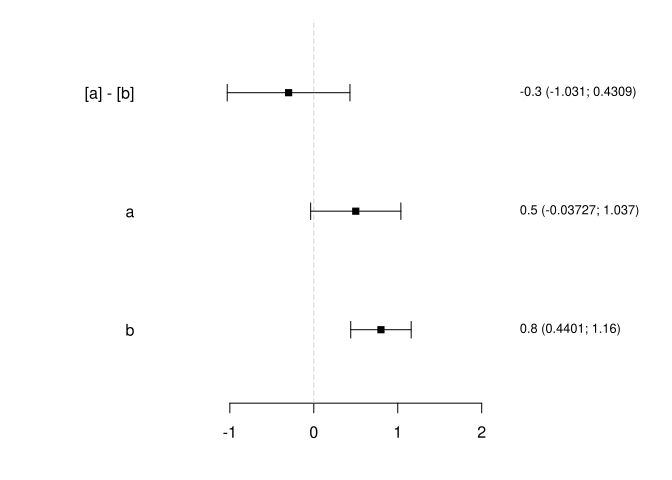
Structural Equation Model
Specify structural equation models with two factors
m <- lvm()
regression(m) <- y1 + y2 + y3 ~ u1
regression(m) <- z1 + z2 + z3 ~ u2
latent(m) <- ~ u1 + u2
regression(m) <- u2 ~ u1 + x
regression(m) <- u1 ~ x

plot(m)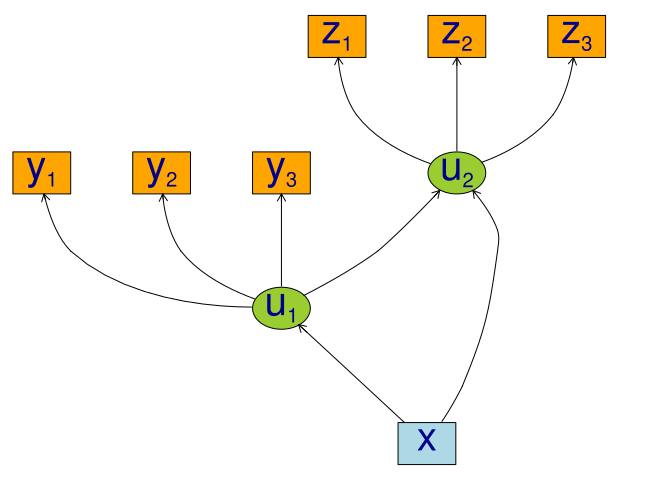
Simulation
d <- sim(m, 100, seed=1)Estimation
e <- estimate(m, d)
e
#>                     Estimate Std. Error  Z-value   P-value
#> Measurements:
#>    y2~u1             0.95462    0.08083 11.80993    <1e-12
#>    y3~u1             0.98476    0.08922 11.03722    <1e-12
#>     z2~u2            0.97038    0.05368 18.07714    <1e-12
#>     z3~u2            0.95608    0.05643 16.94182    <1e-12
#> Regressions:
#>    u1~x              1.24587    0.11486 10.84694    <1e-12
#>     u2~u1            0.95608    0.18008  5.30910 1.102e-07
#>     u2~x             1.11495    0.25228  4.41951 9.893e-06
#> Intercepts:
#>    y2               -0.13896    0.12458 -1.11537    0.2647
#>    y3               -0.07661    0.13869 -0.55241    0.5807
#>    u1                0.15801    0.12780  1.23644    0.2163
#>    z2               -0.00441    0.14858 -0.02969    0.9763
#>    z3               -0.15900    0.15731 -1.01076    0.3121
#>    u2               -0.14143    0.18380 -0.76949    0.4416
#> Residual Variances:
#>    y1                0.69684    0.14858  4.69004
#>    y2                0.89804    0.16630  5.40026
#>    y3                1.22456    0.21182  5.78109
#>    u1                0.93620    0.19623  4.77084
#>    z1                1.41422    0.26259  5.38570
#>    z2                0.87569    0.19463  4.49934
#>    z3                1.18155    0.22640  5.21883
#>    u2                1.24430    0.28992  4.29195
Model assessment
Assessing goodness-of-fit, here the linearity between u2 and u1 (requires the gof package)
# install.packages("gof", repos="https://kkholst.github.io/r_repo/")
library("gof")
set.seed(1)
g <- cumres(e, u2 ~ u1)
plot(g)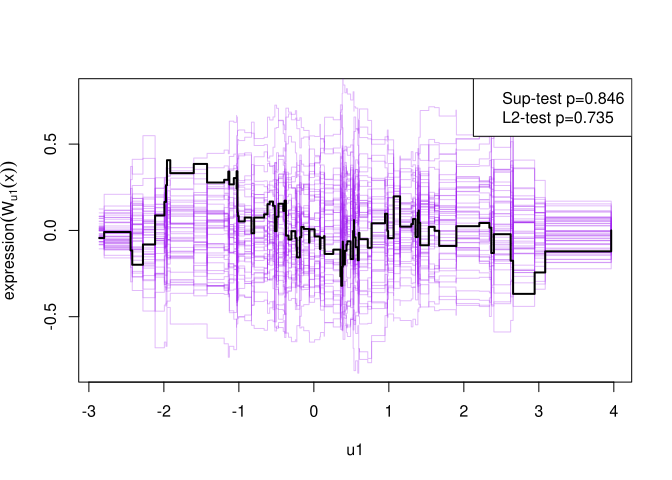
Non-linear measurement error model
Simulate non-linear model
m <- lvm(y1 + y2 + y3 ~ u, u ~ x)
transform(m,u2 ~ u) <- function(x) x^2
regression(m) <- z~u2+u

d <- sim(m,200,p=c("z"=-1, "z~u2"=-0.5), seed=1)
Stage 1:
m1 <- lvm(c(y1[0:s], y2[0:s], y3[0:s]) ~ 1*u, u ~ x)
latent(m1) <- ~ u
(e1 <- estimate(m1, d))
#>                     Estimate Std. Error  Z-value  P-value
#> Regressions:
#>    u~x               1.06998    0.08208 13.03542   <1e-12
#> Intercepts:
#>    u                -0.08871    0.08753 -1.01344   0.3108
#> Residual Variances:
#>    y1                1.00054    0.07075 14.14214
#>    u                 1.19873    0.15503  7.73233
Stage 2
pp <- function(mu,var,data,...) cbind(u=mu[,"u"], u2=mu[,"u"]^2+var["u","u"])
(e <- measurement.error(e1, z~1+x, data=d, predictfun=pp))
#>             Estimate Std.Err    2.5%   97.5%   P-value
#> (Intercept)  -1.1181 0.13555 -1.3838 -0.8524 1.602e-16
#> x            -0.0537 0.14361 -0.3352  0.2278 7.085e-01
#> u             1.0039 0.12651  0.7560  1.2519 2.093e-15
#> u2           -0.4718 0.05858 -0.5867 -0.3570 7.974e-16
f <- function(p) p[1]+p["u"]*u+p["u2"]*u^2
u <- seq(-1, 1, length.out=100)
plot(e, f, data=data.frame(u))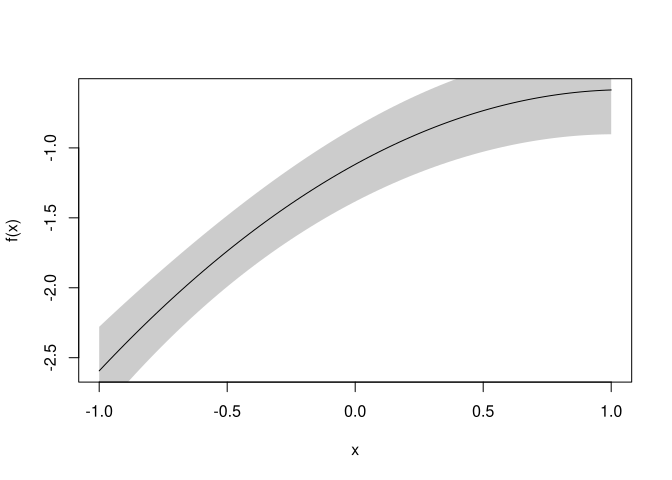
Simulation
Studying the small-sample properties of a mediation analysis
m <- lvm(y~x, c~1)
regression(m) <- y+x ~ z
eventTime(m) <- t~min(y=1, c=0)
transform(m,S~t+status) <- function(x) survival::Surv(x[,1],x[,2])
plot(m)
plot(m)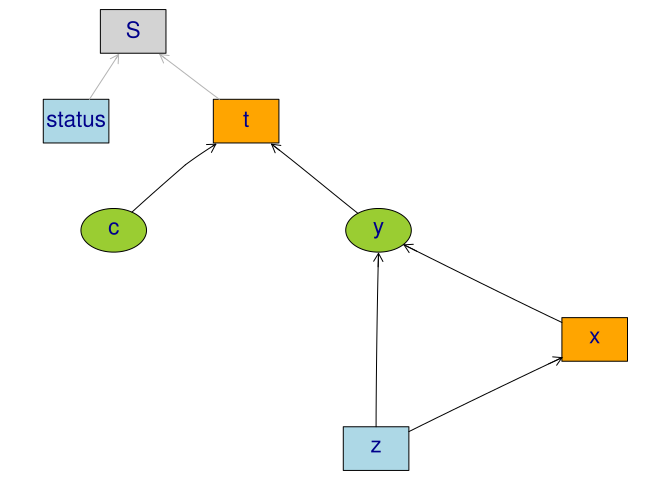
Simulate from model and estimate indirect effects
future::plan("multicore") # parallelization via future
## progressr::handlers(global=TRUE) # add progress-bar
onerun <- function(...) {
  d <- sim(m, 100)
  m0 <- lvm(S~x+z, x~z)
  e <- estimate(m0, d, estimator="glm")
  vec(summary(effects(e, S~z))$coef[,1:2])
}
val <- sim(onerun, 100)
summary(val, estimate=1:4, se=5:8, short=TRUE)
#> 100 replications                 Time: 2.154s
#>
#>         Total.Estimate Direct.Estimate Indirect.Estimate S~x~z.Estimate
#> Mean           1.99533         1.00468           0.99066        0.99066
#> SD             0.18662         0.16553           0.17792        0.17792
#> SE             0.18258         0.17507           0.16503        0.16503
#> SE/SD          0.97835         1.05767           0.92755        0.92755
#>
#> Min            1.49759         0.56922           0.50331        0.50331
#> 2.5%           1.66826         0.68806           0.67154        0.67154
#> 50%            1.96614         1.00175           0.97848        0.97848
#> 97.5%          2.39620         1.29212           1.35790        1.35790
#> Max            2.63461         1.42005           1.47636        1.47636
#>
#> Missing        0.00000         0.00000           0.00000        0.00000
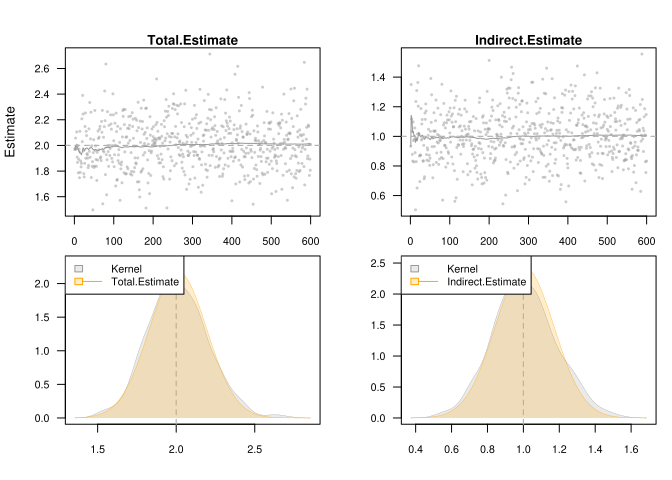
Add additional simulations and visualize results
val <- sim(val,500) ## Add 500 simulations
plot(val, estimate=c("Total.Estimate", "Indirect.Estimate"),
     true=c(2, 1), se=c("Total.Std.Err", "Indirect.Std.Err"),
     scatter.plot=TRUE)