Fits a semiparametric proportional odds model where: $$ \mbox{logit}(S(t|x)) = \log(\Lambda(t)) + x \beta $$ Thus, covariate effects represent the odds ratio (OR) of survival.
Details
This is equivalent to using a hazards model: $$ Z \lambda(t) \exp(x \beta) $$ where \(Z\) is gamma distributed with mean and variance 1.
References
Eriksson, Frank, Li, Jianing, Scheike, Thomas, and Zhang, Mei-Jie (2015). "The proportional odds cumulative incidence model for competing risks." Biometrics, 71(3), 687–695.
Examples
data(TRACE)
dcut(TRACE) <- ~.
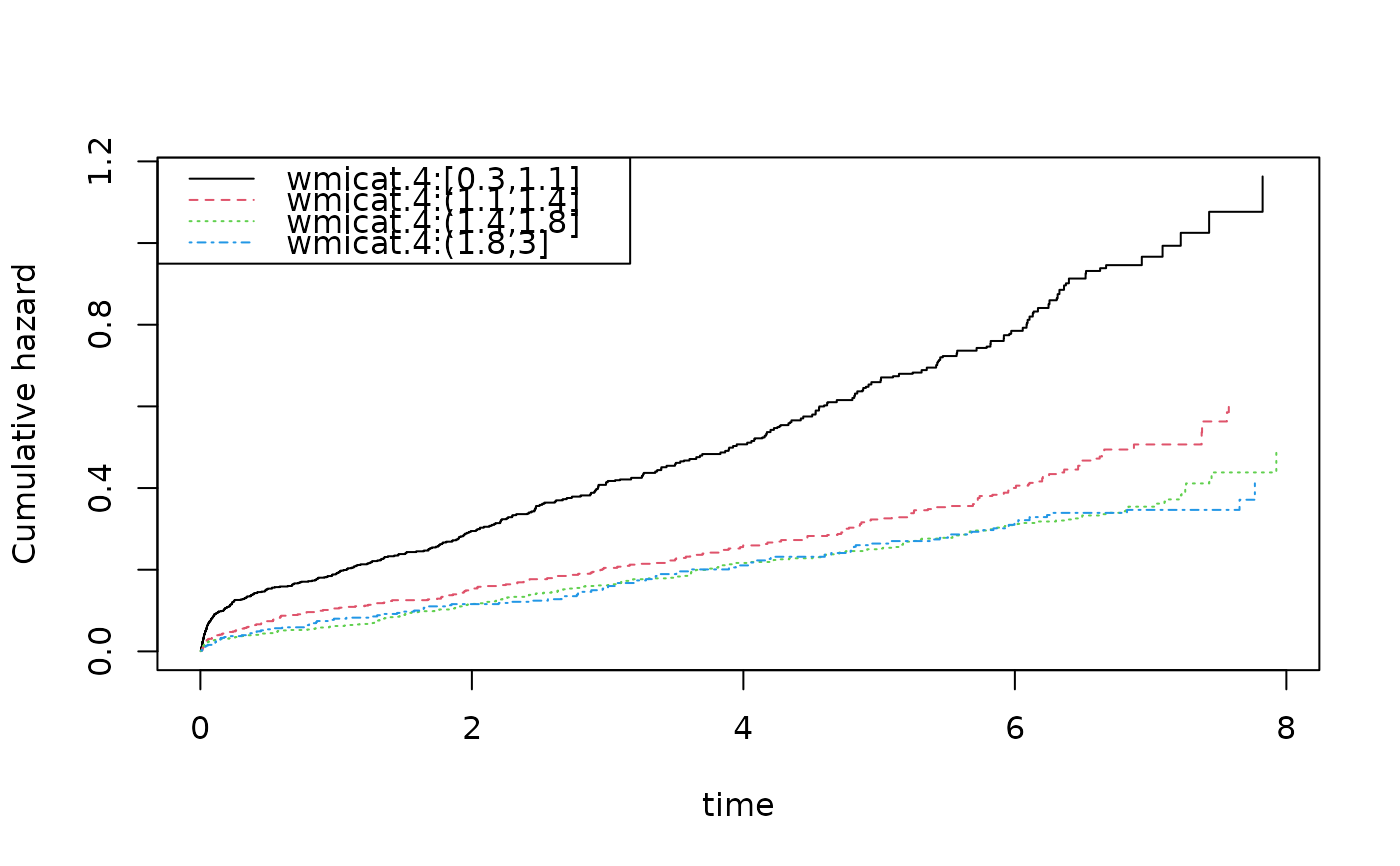
out1 <- logitSurv(Surv(time, status == 9) ~ vf + chf + strata(wmicat.4), data = TRACE)
summary(out1)
#>
#>     n events
#>  1878    958
#> coefficients:
#>     Estimate    S.E. dU^-1/2 P-value
#> vf   0.30049 0.22633 0.11154  0.1843
#> chf  1.26008 0.10095 0.07316  0.0000
#>
#> exp(coefficients):
#>     Estimate    2.5%  97.5%
#> vf   1.35052 0.86667 2.1045
#> chf  3.52570 2.89277 4.2971
#>
gof(out1)
#> Cumulative score process test for Proportionality:
#>     Sup|U(t)|  pval
#> vf   42.28659 0.000
#> chf  20.75308 0.485
plot(out1)